
Proven autonomy, narrowed to a route.
Autonomous driving already works in far more open environments than a bus route. Our work is to adapt that technology to fixed-route public transport, integrate it with real vehicles, validate it, and make the process repeatable.
Perception, prediction, planning. On a route it learns by heart.
Because the route is fixed, the operating domain can be mapped in advance, validated against, and expanded one route at a time. What runs on the bus is the same stack tested against that map.
The live view is unavailable. Ugo's route simulation and validation process are described below.
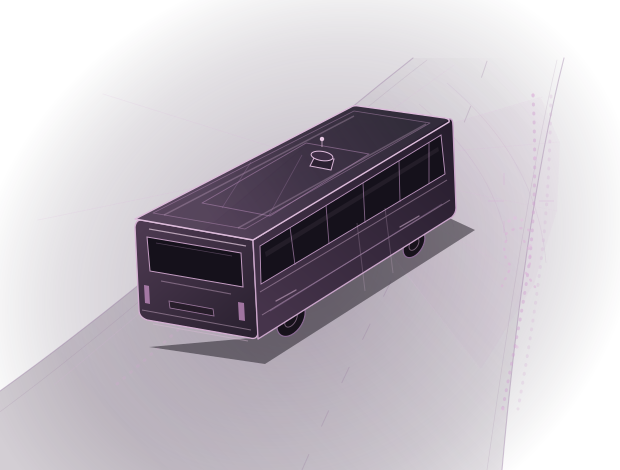
The bus pulls into a stop, lets a passenger off and yields at the crossing. Illustrative visualization, not recorded vehicle data.
The stack.
- Localization
Maps of the route, with LiDAR and GNSS/IMU placing the bus precisely on them.
- Perception
Detects and tracks vehicles, cyclists and pedestrians around the bus.
- Prediction
Estimates where each road user is likely to go next.
- Planning
Chooses a path and speed for the vehicle: lane keeping, stops, docking and yielding.
- Control
Turns the plan into steering, braking and propulsion commands through the retrofit kit.
- Safety supervisor
Watches the whole system and is designed to bring the bus to a controlled stop when something is wrong.
Safety is a process, not a feature.
- Safety driver
Early testing and deployments run with a safety driver on board who supervises, intervenes and logs.
- Controlled stop
If the system degrades, the bus is designed to reach a minimal-risk condition rather than carry on.
- Standards
We design toward ISO 26262, ISO 21448 and UL 4600, with cybersecurity and software updates per UN R155 and R156. This states our intent, not a certification.
- Evidence
Simulation coverage, test logs and safety analyses build up route by route, and decide when a route expands.
From simulation to the street, one gate at a time.
-
Done
System architecture
Software stack, sensor concept and safety concept defined for fixed-route city buses.
-
Done
Operator validation
First-route requirements defined together with European transit operators.
-
We are here
Simulation
Digital twins of real routes to develop and test the full stack.
-
Coming soon
Hardware-in-the-loop
Real compute and sensors in the loop, simulated world.
-
Closed course
The retrofitted bus on a private track, edge cases staged on purpose.
-
Supervised on-road
Public roads with a safety driver who supervises, intervenes and logs.
-
Commercial operations
Autonomous service on a defined route with an operator, expanded as evidence and approvals allow.
Drag, swipe or scroll to explore. Arrow keys when focused.